Fabrizio De André
Our work?
An example of the circular economy
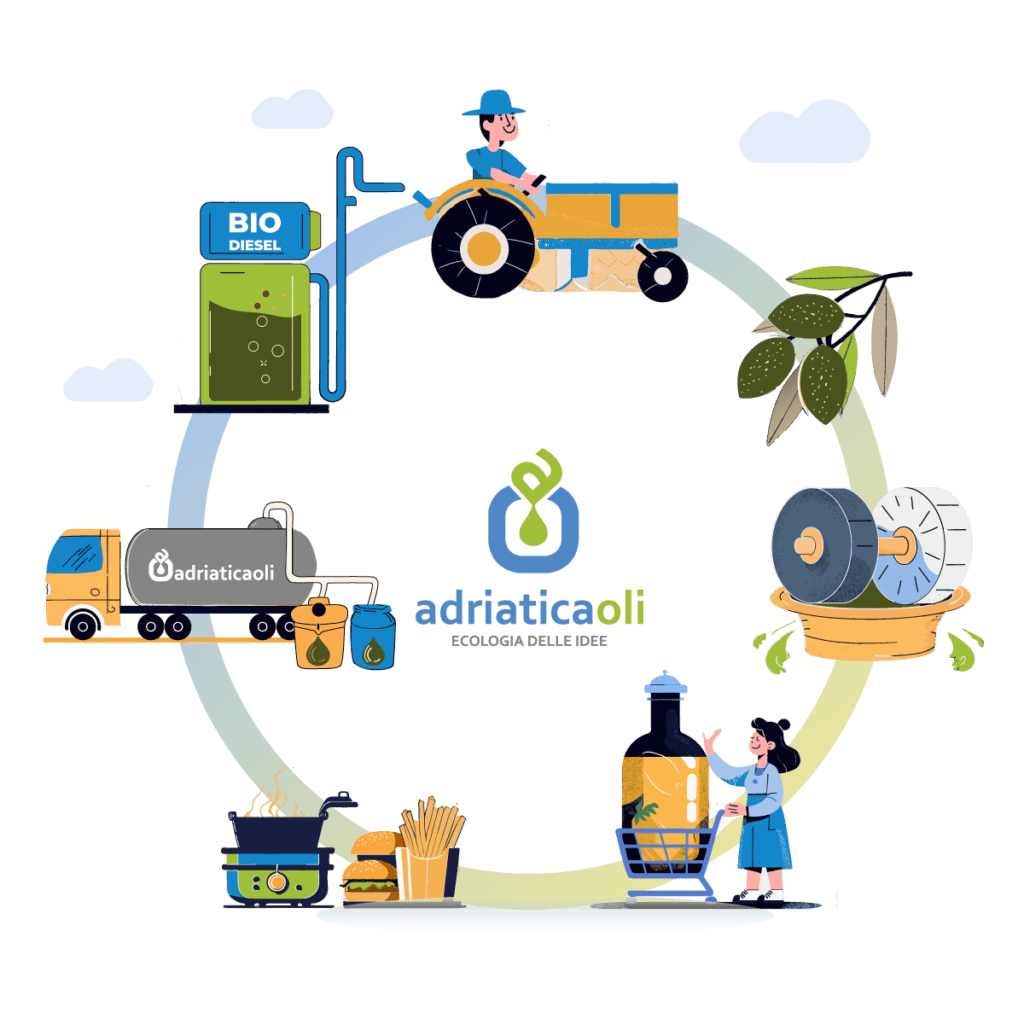
For 40 years, Adriatica Oli has been engaged in the collection, transport, recovery, and disposal of hazardous and non-hazardous special waste, with a particular focus on the regeneration of used vegetable oils. We implement concrete measures to create a virtuous cycle of waste recovery, transformation, and valorization, respecting the environment and benefiting society.
Founded in 1984 in the Marche region, the company operates throughout Italy thanks to a well-established network of partners. Adriatica Oli, now a Benefit Corporation, is committed to making a positive impact while upholding our core values.
The Ecology of Ideas
“Ecology of Ideas” has always been the motto that has defined us since our inception. Every new initiative, as well as every project undertaken over the years, has always been guided by a deep environmental consciousness—an ecological mindset that, by taking root in reality, translates into concrete action. Our “Ecology of Ideas” has been defined from the very beginning as a service to the community and the environment; over the years, this regenerative approach has multiplied our commitment on multiple levels, amplifying our impact on areas and topics that help reposition us in innovative ways.
PROSPERITY
We are a Benefit Corporation dedicated to fostering growth and innovation in the circular economy of waste management
PLANET
We protect water, air, and land through “green fire,” reducing marine pollution and CO2 emissions
PEOPLE
We build trust, well-being, and meaningful connections for employees, partners, and communities
BUILDING TOGETHER
Share ideas, achieve success
Our philosophy is simple: together we are stronger.
We work with our stakeholders to share the value we generate through initiatives that amplify the positive impact of our work, starting with the management of hazardous waste
Sapi Green Oil
Sapi Green Oil is a company within the SAPI S.p.A. group that is entirely dedicated to the collection and regeneration of used vegetable oil for the production of biofuels. https://www.sapigreenoil.it/
Horeca Group
Horeca Group is a network of companies operating in different yet highly complementary sectors that work together synergistically to provide integrated strategic solutions to all operators in the “Hotel, Restaurant, Catering” sector and related fields.

Conoe
CONOE is a consortium established to organize, oversee, and monitor the supply chain for used vegetable and animal oils and fats for environmental purposes, to protect public health, and to reduce waste disposal by transforming an environmental and economic cost into a renewable resource.
Unioli
Unioli is a company specializing in the sale of three main premium-quality products: extra virgin olive oil, seed oil, and tomato pulp. Unioli was founded with the goal of bringing excellence and flavor to the kitchens of restaurants, hotels, and food service companies, committed to offering only the best to meet the needs of customers in the professional culinary world.
GoodCom
GoodCom - Società Benefit is a company operating in the field of communication with the goal of promoting the strategic value of sustainability in economic, social, and environmental terms. Thanks to a team of experts, it develops and communicates “best practices” through targeted initiatives based on high-quality, practical content and on the belief that business profitability cannot be separated from a culture of sustainability that is both comprehensive and integrated.
GT Hub
GTHUB srl (Green Technologies Hub) is a commercial company that offers sustainable services and products tailored to meet the specific needs of the HORECA sector (Hotels, Restaurants, and Catering) and beyond.
Friends
AMIS is a trade association open to public and private companies across the entire waste management sector: from transportation to recovery, disposal, and brokerage. For 30 years, it has served as a point of reference for companies in the sector and provided a forum for fostering collaboration among industry stakeholders.
A.N.C.O.
A.N.CO. | National Association of Consortium Contractors, established in 1982, brings together companies that recover certain types of waste. The Association is composed of various companies, each of which possesses the technical and operational resources and the authorizations required by current legislation to carry out its activities.
Ewaba
The European Waste-based & Advanced Biofuels Association (EWABA) is a nonprofit association dedicated to supporting its members through a unique combination of information, services, and advocacy.
Society of the Works
The Cdo is an association dedicated to supporting entrepreneurs, nonprofit organizations, managers, and professionals in developing their businesses and professional activities with a focus on the common good
We are actively committed to reducing energy consumption and CO2 emissions through continuous innovation. A concrete example of this is the optimization of logistics in the collection of used oil, made possible by the implementation of advanced digital devices for monitoring container fill levels.
We are convinced that adopting cutting-edge technologies is essential to ensuring effective integration between digitalization and environmental sustainability, positioning us as a leader in this sector at the European level.
We recognize the importance of our stakeholders’ cooperation for the success of our efforts. In particular, our restaurant customers and the general public play a key role in ensuring the proper disposal of used cooking oil, thereby contributing to the realization of our circular economy model.
Furthermore, we are committed to promoting a sustainable economic system centered on people’s well-being, balancing economic growth with environmental protection, the promotion of social justice, and the improvement of quality of life.
Sustainable through and through
Founded with a commitment to environmental stewardship and always dedicated to protecting the environment, we are actively committed to reducing our environmental impact and assessing our social and environmental sustainability performance with the utmost transparency.
For a company like ours, the most significant factors are:
- emissions into the atmosphere caused by the operation of company vehicles used for waste collection and the transport of waste leaving the facility.
- the thermal and electrical energy consumption required for oil processing;
- the cost associated with disposing of processing residues at the wastewater treatment plant.
However, our collection system makes sense from a sustainability perspective: in fact, 90% of the collected oils are sent for recycling and converted into biodiesel, a biofuel with a low environmental impact.